
Sleep After 40: What Actually Improved My Sleep (With Data)
After 40, sleep stops being “rest” and becomes a core system for managing your resource: mood, stress, hormones, recovery, and focus. I didn’t learn this from books—I learned it from real life: noise, overload, night awakenings. I built a sleep protocol, started measuring, and saw one simple truth: sleep either upgrades every part of my life, or quietly drags it down.
How One Relentless Dog Pushed Me Into a Sleep Experiment
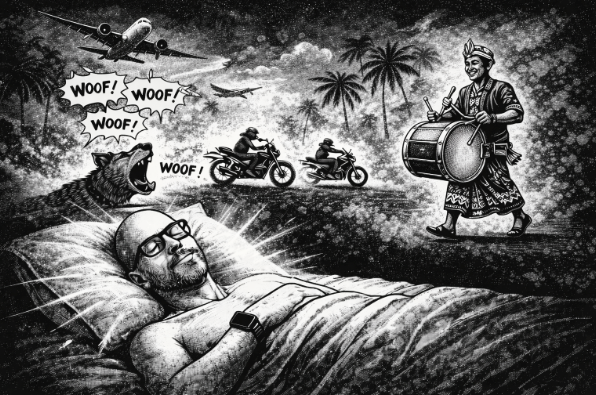
Before trackers and HRV measurements, a dog started appearing across from our house — a dog that genuinely believed the night was the right time for self-expression. From 11:00 PM to 3:00 AM. Regularly.
Conversations with the neighbors ended with me being sent… to court. Earplugs did not work. Replacing the windows (in a rental house!) helped partially. And in that half-asleep state, my brain started generating ideas that would definitely deserve their own article in the criminal code.
And then I understood one simple thing: I cannot control the dog. But I can control myself.
If noise is inevitable, sleep has to become stronger.
Since the beginning of 2024, I started logging my subjective sleep quality every day in a spreadsheet and looking for patterns. I became curious about what actually makes a difference. I started studying circadian rhythms, the effects of cortisol and melatonin, light, temperature, evening rituals, 4-7-8 breathing, and a digital “sunset.”
Going to bed stopped being a habit. It became a protocol.
The irony is that now I sleep better. And even when that dog still wakes me up sometimes, I am no longer angry. In a way, she is exactly the reason I started taking sleep seriously.
What Sleep Actually Does After 40
When I started exploring sleep, I expected to hear something banal: “sleep 8 hours and happiness will follow.” But sometimes I woke up and felt… unhappy.
But the deeper I dug, the more I understood — it is not about “eight hours.” It is about the fact that during the night the body does work it simply does not have time to do during the day.
And after 40, that work becomes critically important.
I am not a doctor. But I read research carefully. And if I simplify it into normal human language, this is what it comes down to.
Sleep is the body’s night-time accounting
During the day, I spend resources: stress, decisions, negotiations, workouts, emotions, coffee, alcohol, sex.
At night, the body has to put all of it back into order.
During sleep:
- the nervous system recovers
- stress levels go down
- hormones rebalance
- the brain gets “cleaned”
- metabolism stabilizes
If sleep is weak, I wake up technically alive, but the system is already operating in debt.
At 30, this is almost invisible. At 45, you can already feel it.
The Most Important Thing I Understood
Sleep is not about tiredness. It is about regulation.
Testosterone
A large part of its daily dynamics is tied to sleep. Poor sleep means lower recovery, lower drive, lower energy. It hits libido, motivation, strength, and a man’s overall sense of tone and vitality.
Fact: in a study of healthy men, one week of sleeping about 5 hours per night was associated with a 10–15% drop in daytime testosterone.
https://jamanetwork.com/journals/jama/fullarticle/1029127
Cortisol
If I sleep badly, it is above normal in the morning. I wake up not calm, but already in fight mode. And that accumulates.
Metabolism
A few nights of bad sleep — and food cravings go up, control gets worse, and fat is stored more easily.
After 40, this is no longer theory. It is practice.
Why This Became Personal for Me
In my sleep analytics spreadsheet, I noticed a pattern:
Poor sleep → less energy and less desire to solve difficult tasks → more irritability → weaker concentration → my baseline operating level goes down
(and the saddest part is that my sense of happiness goes down with it).
I seem to function as usual, but the reserve of energy and resilience is no longer the same.
And this is where the adult part begins.
After 40, you cannot live in the mode of “I’ll catch up on sleep over the weekend.”
The body no longer forgives that easily.
I realized one simple thing: if sleep is removed from the foundation, nothing else scales.
You can work out, take supplements, and count calories, but if sleep is unstable, the entire system stays shaky.
That is exactly why improving sleep became a foundational strategy for me.
Why Sleep Becomes Fragile After 40. My Top 10
After 40, sleep often gets worse not because of “old age,” but because of a combination of factors: stress and an overloaded nervous system, circadian rhythm shifts, less daytime movement and morning light, more evening light and screen exposure, alcohol used as a “calming tool,” plus a higher risk of apnea due to weight and breathing-related factors. This is not a sentence — it is a sleep settings failure that can be brought back to normal.
- Stress and an overheated nervous system
Why “I’m tired but I can’t fall asleep” is normal for entrepreneurs, and why the brain does not switch off in the evening. - Circadian rhythm: light matters more than I thought
Morning light versus evening light, and why a digital sunset really works. - Alcohol: a fast off-switch that breaks recovery
Why it feels like it helps you fall asleep, but the quality of sleep gets worse. - Temperature, noise, environment: small things that decide the fate of the night
Cool air, darkness, barking/noise, and why the perfect bedroom is not aesthetics — it is a tool. - Age-related changes: yes, they exist — but they are not the main thing
A little less deep sleep, a little more sensitivity to disruption — and that is why the protocol has to be tighter. - Red flags: when this is no longer “just poor sleep”
Snoring, breathing pauses, daytime sleepiness, frequent awakenings — and why these things are worth checking. - Caffeine and stimulants (and their hidden sources)
After 40, sensitivity is higher, and “no caffeine after 4 PM” no longer works for many people the way it did at 25. - Food and dinner timing
Late heavy meals, sugar, snacking, stress-eating compensation → sleep becomes fragmented. - Physical activity and its timing
Not just “exercise is good,” but when and how much: too little movement during the day and workouts too late in the evening are two different problems, and both hurt sleep. - Medication, supplements, and medical background
Some things can worsen sleep — or mask the real problem. This matters, and it should be addressed neutrally, without trying to scare people.
And when I realized this was not one problem but a whole set of levers, I stopped looking for the perfect pill and started building sleep as a system: first measurement, then basic changes, then fine-tuning — exactly the same way I would set up any business process.
How I Started Fighting It: My Sleep Protocol
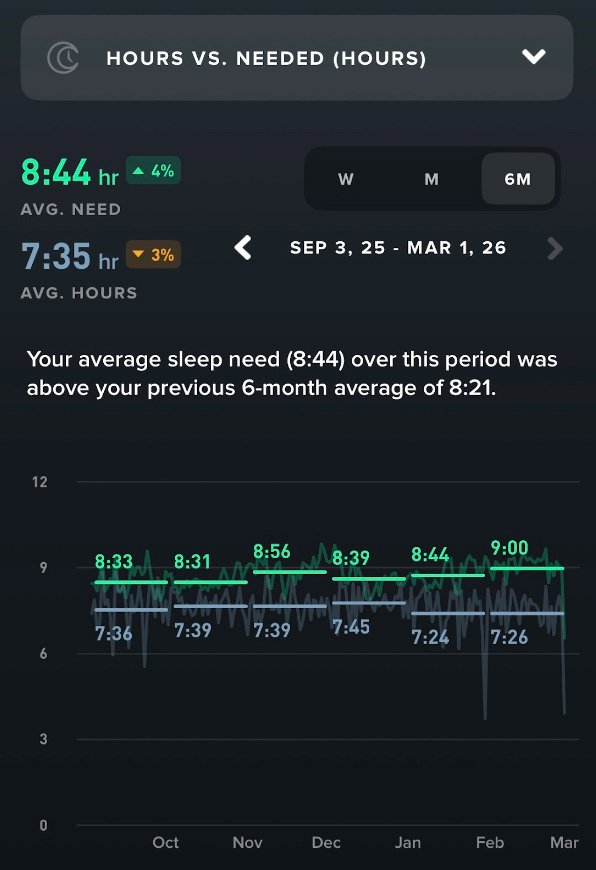
The first thing I locked in was going to bed early and waking up early: now I usually go to bed around 9:00 PM and get up at 5:00–6:00 AM, before sunrise. From the outside, that looks like “almost 9 hours of sleep,” but the tracker sobers you up quickly: I spend 8–9 hours in bed, but in reality I sleep an average of about 7, because some of that time gets eaten by falling asleep and waking up during the night. So I stopped counting how long I lay there and started counting how long I actually slept.
I set a shutdown timer for most apps: from 8:00 PM to 9:00 AM, my messengers and social media are blocked, and only the reading app remains. In real life, this created two different worlds — a quiet evening and morning for myself, and the daytime world of tasks and news. Plus, my phone screen automatically switches into a warm evening light mode. The result is that I reduce digital cortisol — evening overstimulation caused by notifications and news.
By the way, WHOOP shows a noticeable decrease in stress when I read before bed, and it often records that as meditation.
- I changed all the lighting in the house: I installed 3000K neutral-warm bulbs. The bonus turned out to be unexpectedly pleasant: the house started looking better. And the cold blue light that people in Indonesia seem to love finally stopped irritating me.
- I used to love good coffee: making it in the morning, sitting quietly, drinking it with my wife. But I started noticing a strange pattern — sometimes coffee made my heart rate spike. And the worst part was that it did not happen “at home on the sofa.” It would happen during important meetings: you arrange a negotiation, show up at some new restaurant, order coffee to wake yourself up — and instead of feeling sharper, you get tachycardia, sweat, and start chugging liters of water while trying to look like someone who has everything under control.
At some point I realized this was too expensive a lottery. So I just removed coffee.
At the same time, I discovered dozens of kinds of tea that I genuinely enjoy, and now I drink a lot of it — and unlike coffee, tea generally contributes to hydration rather than forcing you to make up for it later.
The hardest negotiations I had were not with the neighbors, and not even with the dog — they were with myself about alcohol.
- I like good wine, prosecco, sometimes beer with friends. In reasonable amounts. Culturally. Like an adult who “has everything under control.” The problem is that in the morning, control usually belongs to alcohol, not to me.
If I drank more than usual and came home around midnight, the payback was completely disproportionate: two or three hours of socializing turned into two or three days of a strange condition where you are technically alive, but inside it is minus energy, minus mood, minus desire to handle work tasks. And the worst part was that feeling of unhappiness for no obvious reason, as if someone had quietly turned the brightness of life down by 70%.
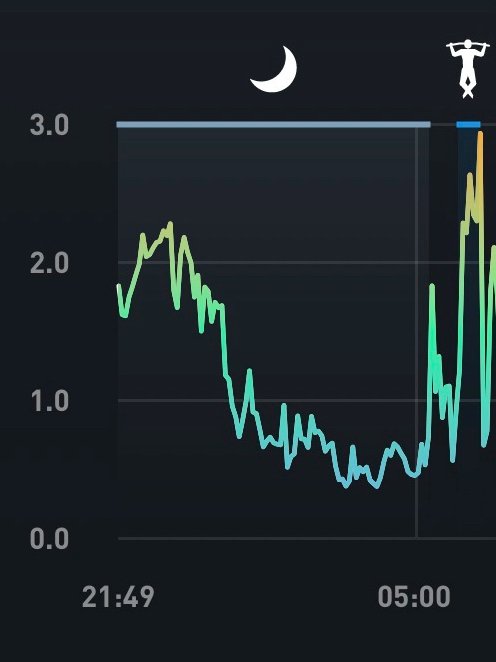
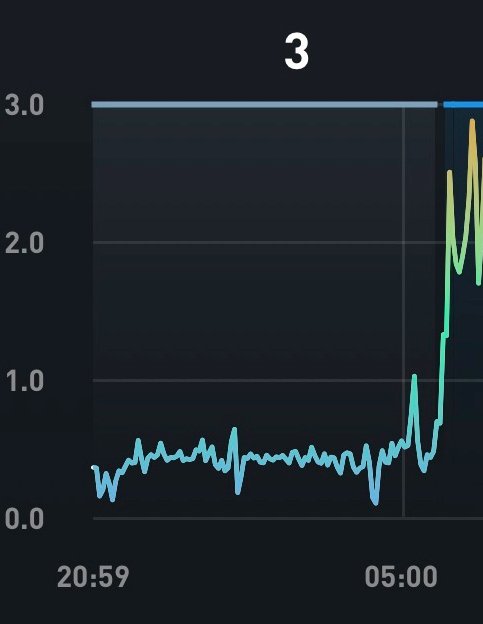
Caption
After doing that math, the choice became obvious: I needed to say goodbye to alcohol.
Now I can sometimes have one or two glasses, but honestly — in the morning I almost never find a good answer as to why. I cannot say that it really adds anything important to my life. But I can say that it reliably takes away sleep, energy, and mood. And that is no longer a profitable trade.
Next came food. I noticed that a late and heavy dinner almost guaranteed worse sleep, even if you “fell asleep normally.”
So I have one simple rule: I do not eat after 7:00 PM. I give my body at least 12 hours without food until the next meal. I do not need some extreme fasting performance act — I need stable sleep.
And even more important: no heavy food in the evening. Because when the stomach is working at night, the brain does not really want to rest.
- A simple rule — get tired in order to fall asleep.
The more normal, healthy tiredness I build up during the day, the easier it is to switch off at night.
And there is one more small action that works almost every time: after dinner, I go for a walk. It is not a workout, not some heroic act — just 20–40 minutes of walking so the body can calm down and the mind can stop replaying the day in circles.
And unexpectedly, this also gave me a bonus I had not planned at all: during these walks, we start talking with the children about things that somehow never come up at home. In the end, those evening walks became not only about sleep, but also about the fact that we genuinely became closer.
- Thought dump into a notebook: before bed, I quickly write down everything that is spinning in my head, put a period at the end of the day, and close it — so I do not keep chewing on it in bed.
- Magnesium glycinate became my inseparable bedtime companion. And glycine became an occasional helper: if I feel overstimulated, if the timing of the day got messed up, or if my head is still running at full speed, I turn to glycine — and most of the time, it helps.
In the end, this cocktail of simple actions significantly improved my sleep — and I now have more energy than I did at 35.
Why This Works (In Plain Language, but with Research)
Stress and an overheated nervous system
When you spend the whole day under tension, the brain often does not switch into sleep mode even if the body is tired — this is called the hyperarousal model of insomnia. In simple terms, the alarm system does not switch off. If you remove stimulation in the evening and close the day properly, you genuinely help the brain leave that mode.
Review: what hyperarousal in insomnia is and why “tired but can’t sleep” is not a whim
Circadian rhythm and light
Bright or blue light from screens in the evening can suppress melatonin, shift the biological clock, and worsen both falling asleep and morning alertness — this has been shown in experimental work with eReaders.
Experiment: evening eReader use → lower melatonin, later sleep onset, worse alertness in the morning
Alcohol
Alcohol really can speed up the switch-off, but then it often causes fragmented sleep and reduces REM, which means worse recovery even if, subjectively, you feel that you “fell asleep quickly.”
Reviews/data: why alcohol worsens sleep quality and recovery in the second half of the night
Temperature, noise, environment
A comfortable thermal environment affects sleep quality, but the ideal temperature is not universal: research shows that the perception of cold or heat, as well as climate and habit, changes the picture significantly. So the principle that works is cooler and more stable — but adjusted to you.
Reviews: how temperature and thermoregulation affect sleep
Age-related sleep changes
As we age, sleep often becomes lighter, with more awakenings and less deep sleep — this is normal biology. That is why after 40 the price of mistakes such as alcohol, light exposure, or late meals becomes higher.
Review: which sleep changes are typical in normal aging
Red flags and apnea
Excess weight is one of the key risk factors for obstructive sleep apnea, and apnea damages sleep through micro-awakenings and strain on the cardiovascular system. So “snoring + daytime sleepiness” is not a personality trait — it is a reason to check your breathing during sleep.
NHLBI/NIH: causes and risk factors of sleep apnea
Caffeine and stimulants
Caffeine can damage sleep even when taken 6 hours before bedtime — in a study based on real-life conditions, it reduced sleep duration and worsened subjective sleep measures.
Study: caffeine taken 0/3/6 hours before bed and its effect on sleep
Food and dinner timing
Late meals and a generally later eating schedule are associated in chrono-nutrition research with poorer sleep quality, and experimental studies suggest that dinner too close to bedtime can worsen both sleep onset and sleep itself.
Observational data: “normal dinner” vs “late dinner”
Physical activity and its timing
Regular physical activity improves sleep quality and insomnia symptoms according to meta-analyses, but training that is too intense late in the evening can interfere with falling asleep. That is why an evening walk works as a soft braking system for the body.
Review: connection between physical activity and sleep quality
Medication, supplements, and medical background
With age, people are more likely to take medications and have health conditions that affect sleep. That is why sometimes the protocol does not work until you take medical background and possible side effects into account.
NIA/NIH: sleep in older adults, impact of health conditions and medications
Bonus — the gold standard if insomnia becomes chronic
If sleep has really fallen apart for a long time, clinical guidelines usually place CBT-I (cognitive behavioral therapy for insomnia) as the first step before medication.
ACP guideline: CBT-I as first-line treatment for chronic insomnia
How I Measure Sleep (and Why I Do Not Give Full Power to the Tracker)
I measure sleep with the WHOOP tracker, but I still keep the final decision for myself. Because WHOOP gives useful averages and trends, but it can make mistakes — like any device. So I have one simple rule: the tracker is the navigator, and my own feelings are the road under the wheels.
My ideal night looks very specific. I go to bed around 9:00 PM after my rituals, I do not wake up during the night, and the level of stress during sleep stays minimal. Then at 5:00 AM I wake up not in a “more or less okay” state, but in a strong, resourceful one — the kind of state where you want to get up rather than bargain with life for another 20 minutes. Bonus: seeing the sunrise. In Bali, that is a currency of its own.
I think about sleep as a system with two key zones: evening and morning. If evening is the landing, morning is the takeoff. And the most important thing for me is not only how I sleep in the middle of the night, but how the last two hours before bed and the first two hours after waking are structured. Because that is what sets up the quality of the next night.
So I am not trying to sleep perfectly. I am trying to make the landing soft and the takeoff confident. And if WHOOP agrees with how I feel — great. If not, I trust my body, and I use the tracker as a clue about where to look for the cause.
Update for March 2026: Sleep Is Still Not Perfect
I started waking up at night again — usually around 1:00 AM or 3:00 AM — and then I can lie there for almost two hours, just staring into the darkness and counting crows. It is not dramatic, but it is very noticeable. And of course, it immediately shows up in the stats on the screenshot: sleep quality drops, recovery drops, overall resource drops.
Important: I am not writing this from the position of “I fixed everything forever.” At the moment of writing this article (March 2026), the problem has returned — against a background of acute work overload, high stress, and tension.
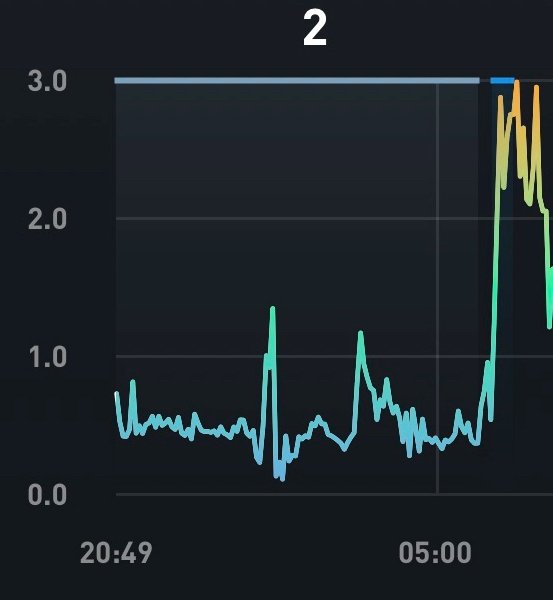
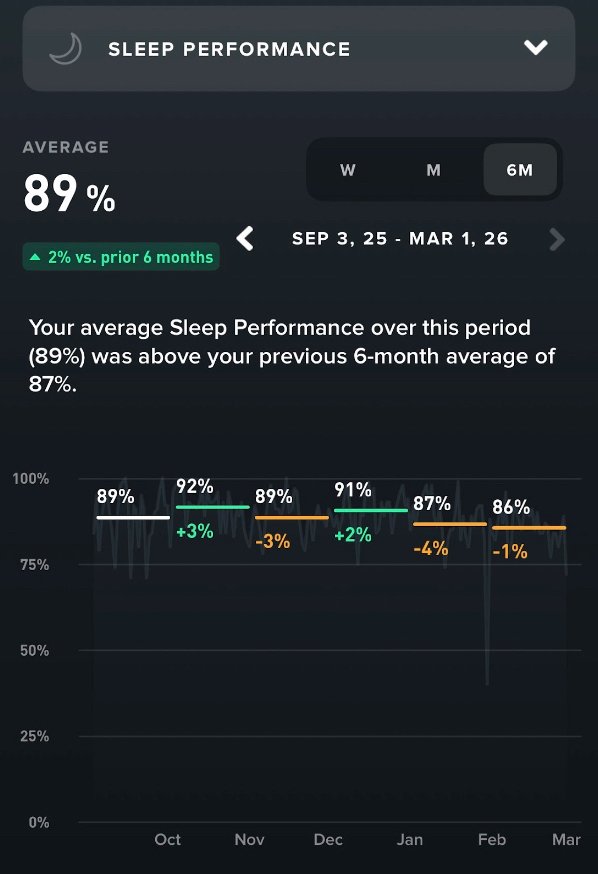
And honestly: for now, I cannot say that I have fully solved this problem. It seems that the root here is not “one more ritual,” but the level of overload itself — something that has to be reduced systematically. I will definitely add to this section and show what worked once I stabilize the routine and pull myself out of this overload.
Even with all that, my current average is around 89%, and I consider that a good result. Because when I look back at 2024 and see how I was sleeping then, I have only one question:
Maksym, how did you even survive?
What We Still Don’t Know (And What I Honestly Do Not Present as Truth)
I love protocols, metrics, and clear systems, but sleep has an unpleasant reality: even if you do everything “right,” it still remains a living process, not a calculator. So here is what I keep in mind and do not try to sell as absolute truth.
- How much deep sleep and REM I personally need. There are average ranges, but two people with the same routine can look very different. Sometimes you wake up strong without ideal percentages, and sometimes the tracker paints a beautiful picture — and you still feel empty.
- Trackers do not see truth — they see a model. WHOOP is useful for trends and patterns, but it is not polysomnography. It can be wrong, especially in the details of sleep stages. That is why I look at dynamics, not at one night as if it were scripture.
- Stress can break sleep harder than any ritual can fix it. My March 2026 is a good example: when overload is acute, you can light a candle, read a mantra, do all the right things — and the brain will still wake up at 1:00 AM and start replaying meetings. Sometimes the root problem is not in the evening protocol, but in the daytime load.
- The ideal night does not scale into real life. I have a family, children, business, flights, deadlines. I do not live in a sleep monastery. So my goal is not sterile perfection, but resilience: a system that can survive real life instead of collapsing after one disruption.
- Supplements are not the foundation — they are situational tools. Magnesium and glycine can help, but they do not replace the base: routine, light, stress management, food, alcohol. And the most honest thing you can say about supplements is that they do not work equally for everyone and they are not always predictable.
- It is not always obvious where poor sleep ends and a medical problem begins. Snoring, apnea, daytime sleepiness, regular night awakenings — these are things that cannot always be solved with discipline alone. Sometimes what you need is not a protocol, but a doctor and a diagnosis.
- Sleep is not only about the night. It starts in the morning: light, movement, stress, decisions, caffeine, alcohol, dinner timing. The night is the result of the day. And sometimes the most powerful sleep hack is not one more evening ritual, but a well-lived day.
I am still running the experiment. And if something changes, I update the article — I do not pretend that everything is solved. My goal is not to write a beautiful article. My goal is to wake up consistently as a person who wants to live and do difficult things.
FAQ: Questions I Asked Myself About Sleep
Q: Sleep Architecture for High-Stakes Decisions — how does deep sleep affect cognitive flexibility in negotiations?
A: I would put it this way: deep sleep does not directly “turn me into a genius negotiator,” but it helps keep executive functions working properly — calm, self-control, strategy switching, and the absence of that stupid “I’m stuck, so I’ll just push harder” mode instead of flexibility. When sleep is lacking — or fragmented — research more often shows a drop in cognitive flexibility and executive function, and that is exactly what you need in negotiations.
Review on sleep deprivation and cognitive flexibility
Meta-analysis/review: sleep restriction → neurocognitive deficits, including executive function
Q: How many hours of sleep do you really need after 40 — and why is “lying in bed for 9 hours” not the same as “sleeping 9 hours”?
Most adults need 7+ hours of sleep regularly. At the same time, time in bed is almost always longer than actual sleep, because part of the time is spent falling asleep and part is lost to micro-awakenings.
AASM/SRS recommendation: “adults should sleep 7 or more hours”
Q: Why do I wake up at 1:00 AM or 3:00 AM and then cannot fall asleep again?
A: A common reason is not weak willpower, but hyperarousal — the wakefulness system stays activated even when the body is tired.
Review on hyperarousal in insomnia
Q: Alcohol — why do I fall asleep faster, but then sleep worse?
A: Alcohol can shorten sleep onset, but then it often leads to fragmented sleep and changes in sleep architecture, including REM suppression. So “I fell asleep fast” does not mean “I recovered well.”
Q: How much can I trust the rule “coffee only in the morning”? Why can it still damage sleep?
A: Caffeine can hurt sleep even without coffee at night: it can make you fall asleep later, sleep less, and sleep more superficially. The effect depends on the dose and individual sensitivity, so the rule “only in the morning” does not work equally well for everyone — for some people, coffee stays in the system longer than expected.
Systematic review and meta-analysis: effect of caffeine on subsequent sleep
Q: When is poor sleep a reason to check for apnea?
A: If there is snoring, breathing pauses noticed by a partner, morning exhaustion, and/or daytime sleepiness, it is worth thinking about apnea. Sleep can look fine by the clock but still be destroyed in quality.
NHLBI/NIH: causes and risk factors of sleep apnea
Q: What should I do if insomnia has become chronic and rituals no longer help?
A: In clinical guidelines for adults, CBT-I (cognitive behavioral therapy for insomnia) is the first step before medication when insomnia becomes chronic.
ACP guideline: CBT-I as initial treatment
Final Thought
I am not looking for perfect sleep. I am looking for sleep that can withstand real life: business, stress, family, flights, and ordinary human days. Some parts of the system I have already built — and that has genuinely given me more energy than I had at 35. Some parts — especially night awakenings during periods of overload — I am still working on. And that is part of the experiment too: I am not painting a beautiful picture, I am documenting reality and gradually improving what can be improved.
If you want to follow the experiment, subscribe. I will keep updating this article as my sleep and my workload change.
Disclaimer
This text is my personal experience and my reading of the research. It is not medical advice and it is not a substitute for consulting a doctor. If you have chronic insomnia, severe daytime sleepiness, snoring or suspected apnea, sudden worsening of sleep, or any condition that interferes with normal life, it is better to discuss it with a doctor (a sleep specialist or physician) and, if necessary, undergo proper diagnostics.